Since 1 January 2022, owners of older and taller buildings in Singapore have had a legal duty to have their facades inspected on a fixed cycle. BCA estimated that around 30,000 buildings fall into the first seven-year round alone. If you sit on a condominium council, manage a commercial building or run a managing agent’s portfolio, the question is not whether a Periodic Facade Inspection (PFI) applies to you, but when.
This guide explains how to tell whether your building is covered, how the timing works, and what has to happen once the Building and Construction Authority (BCA) notice arrives.
Does PFI apply to my building?
A building must be inspected under the PFI regime when it passes two tests at the same time:
| Test | Applies when | Notes |
|---|---|---|
| Height | The building is more than 13 metres tall | Measured from ground level to the building’s highest point. A low block at the same address as a taller tower is not covered on its own. |
| Age | The building is more than 20 years old | Counted from the date the last Temporary Occupation Permit (TOP) was granted for the whole building, or the last Certificate of Statutory Completion (CSC) if there was no TOP. |
| Exemptions | Landed homes and temporary buildings | Detached, semi-detached, terraced and linked houses used as homes are exempt, as are temporary buildings. |
In practice, that captures most condominiums, office blocks, shopping centres, hotels and industrial buildings from the early 2000s and earlier. A building completed in 2006 crosses the 20-year line in 2026.
When is my PFI due?
There is no single calendar date for every building. The date that matters is the one on the Notice of Inspection that BCA serves on the building owner. Three rules decide when that notice comes:
- First inspection: once the building is more than 20 years old. BCA spreads the first round of roughly 30,000 buildings across the first seven-year cycle, so buildings that were already over 20 in 2022 are not all being called at once.
- Advance warning: BCA has committed to sending an advisory at least one year before a building’s inspection is due, so you should hear about it well before the formal notice.
- Every 7 years after that: subsequent inspections fall due in the seventh year or later after the year in which the previous notice was given. A building notified in 2025 should expect its next notice in 2032 or later.
If you are unsure where your building stands, start with the TOP or CSC date in your MCST records or building plans, then check your correspondence for a BCA advisory or notice. Owners who want to get ahead can also write to BCA asking to inspect before a notice is served; BCA considers these requests case by case.
What happens after the BCA notice arrives?
The clock starts on the date of the notice. The sequence is set out in the regulations and BCA’s guidelines:
- Appoint a Competent Person within 2 months. A Competent Person is a Professional Engineer (civil or structural) or Registered Architect who has passed BCA’s Certificate in Façade Inspection. They must have no professional or financial interest in the building.
- The inspection is carried out by the Competent Person, who may be assisted by certified Façade Inspectors working under their supervision.
- The report is submitted to BCA through CORENET once the inspection is complete.
- BCA writes to the owner about the repairs the report recommends, with a period within which they must be completed.
- The repairs are done and certified, with the Competent Person’s certification and photographs submitted at the end.
One exception cuts across the timeline: if the inspection finds anything unsafe, such as loose or dangling elements, it must be made safe immediately and reported to the Commissioner of Building Control straight away, not at the end of the process.
What does the inspection actually involve?
BCA’s guidelines require two layers of inspection on every building:
- A 100% visual inspection of the entire facade, from the ground or other suitable vantage points.
- A close-range inspection of at least 10% of the surface area of each elevation, where the inspector gets within arm’s reach to look, tap and test.
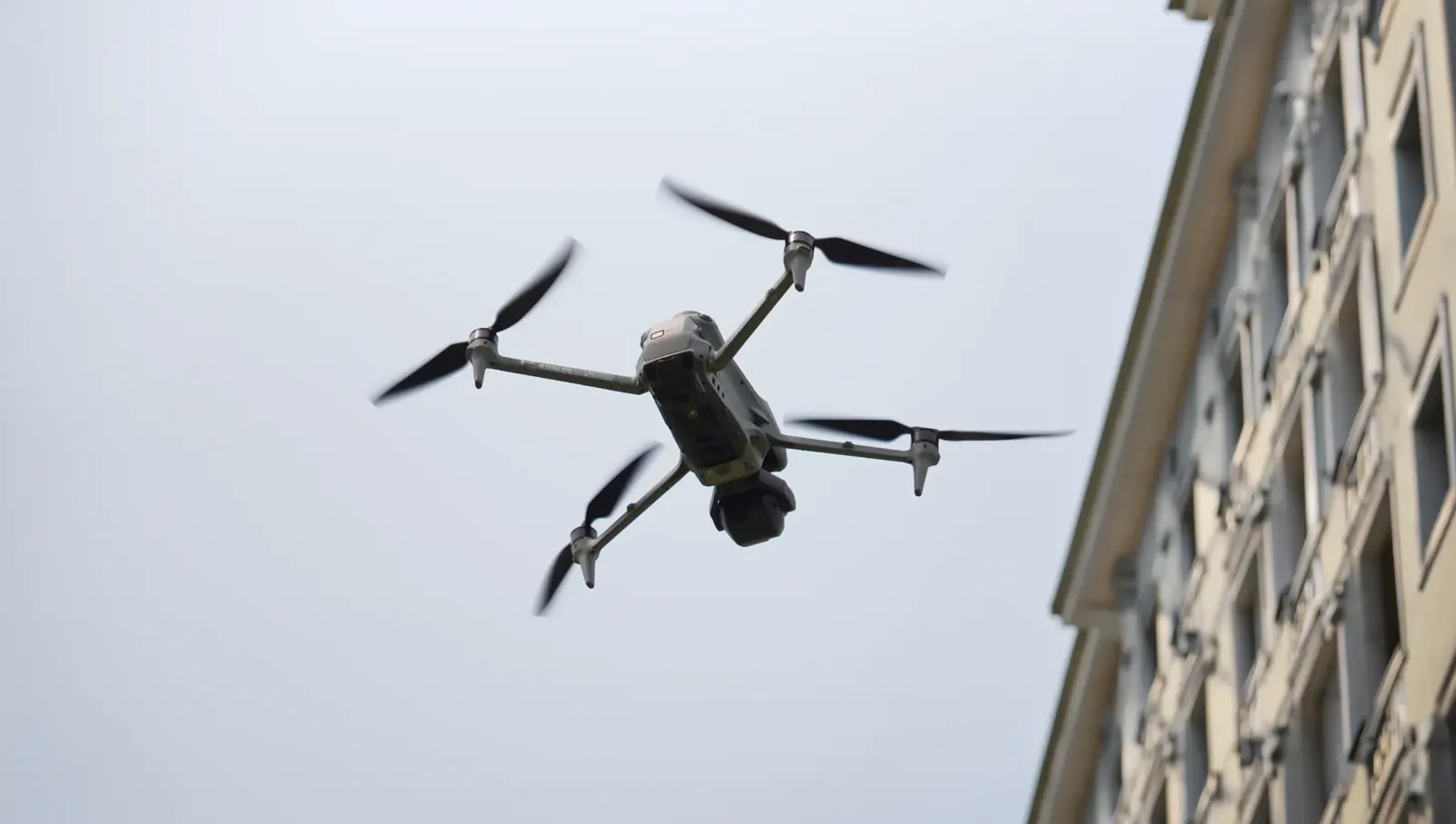
Drones are accepted for the visual stage, and they are now the fastest way to produce a complete, high-resolution photographic record of every elevation without putting anyone at height. Two conditions apply. The Competent Person must notify BCA and get its approval before using a drone, which the Ministry of National Development says is typically issued within 3 working days. The operator must also hold the necessary CAAS permits to fly, and residents must be given at least 3 days’ notice before the flight.
A drone does not replace the 10% close-range inspection. What it does is show the engineer exactly where to look, so close-range access can be targeted at the areas that matter instead of spread blindly across the building. We cover the trade-offs in more detail on our drone facade inspection page.
Who is responsible for the inspection?
The legal duty sits with the building owner. In practice:
- Strata developments (condominiums, strata offices and malls): the management corporation (MCST) arranges the Competent Person and the inspection on behalf of the owners. Individual subsidiary proprietors can ask for their own unit’s facade to be included.
- Buildings with several owners but no strata title: the owners must appoint the Competent Person jointly.
- A building sold mid-process: the duty to inspect and repair does not disappear with the sale. BCA may hold the buyer accountable if the buyer agrees in writing to comply with the notice.
Separately from PFI, owners already have a continuing duty under the Building Maintenance and Strata Management Act to keep exterior features, such as windows, louvres, air-conditioner ledges and cladding, in good repair and securely fixed.
Can the deadline be extended or the inspection deferred?
Sometimes, but only by asking BCA in writing before you miss anything. BCA considers each request case by case:
- Time extensions for practical reasons such as tenancy arrangements or prolonged bad weather.
- Deferral where the facade is about to be reclad or substantially altered, supported by maintenance records, drawings and a timeline.
- Demolition plans, with the expected demolition date.
What does not count: a recent repainting or partial refurbishment does not exempt a building, and routine Repair and Redecoration (R&R) works do not replace PFI. They can, however, be scheduled alongside it. BCA itself suggests timing R&R with the inspection, since the same access and repairs can then serve both.
What are the penalties for missing a PFI?
| Offence | Maximum penalty | Applies to |
|---|---|---|
| Not appointing a Competent Person within the time allowed | Fine of up to $20,000 | Building owner |
| Competent Person failing to inspect as required | Fine of up to $50,000 | Competent Person |
| Failing to keep exterior features in good repair and securely fixed (BMSMA) | Fine of up to $10,000, up to 12 months’ jail, or both | Persons responsible, generally owners |
The fines are only part of the exposure. BCA records more than 20 fallen-facade incidents a year on average. If an unrecorded defect falls and injures someone, the absence of a timely inspection is not a position any owner wants to defend.
How to plan ahead and keep the cost down
- Find your TOP date now and work out when your building turns 20, or when its last notice was served.
- Budget early. BCA asks owners to plan funds for the inspection. For an MCST, that means a sinking-fund line before the notice, not an urgent levy after it.
- Line it up with R&R. If external painting or repairs are due within a year or two, schedule them around the PFI so access is paid for once.
- Use a drone for the 100% visual stage. It replaces days of gondola or scaffold work for the survey and gives the engineer a complete record to direct the close-range checks. For a typical residential block, the drone survey stage is a fraction of the cost of full access equipment.
- Leave time for permits. Allow 1–4 weeks for the drone flight permit depending on location, on top of BCA’s approval, so start the moment you have the notice.
The short version
- PFI applies to buildings over 13 m and over 20 years old (from the last TOP), except landed homes and temporary buildings.
- Your due date is the one on BCA’s Notice of Inspection, with an advisory at least a year earlier. After that, it repeats roughly every 7 years.
- You have 2 months from the notice to appoint a Competent Person. Missing that can cost up to $20,000.
- The inspection is a 100% visual survey (drones are accepted) plus close-range checks on at least 10% of every elevation.
This guide is general information on Singapore’s Periodic Facade Inspection regime as at October 2026, drawn from BCA’s PFI pages, guidelines and FAQs. It is not legal advice; for your building, rely on the notice BCA serves and your Competent Person. See also: drone facade inspection and what a drone operator needs to fly legally.