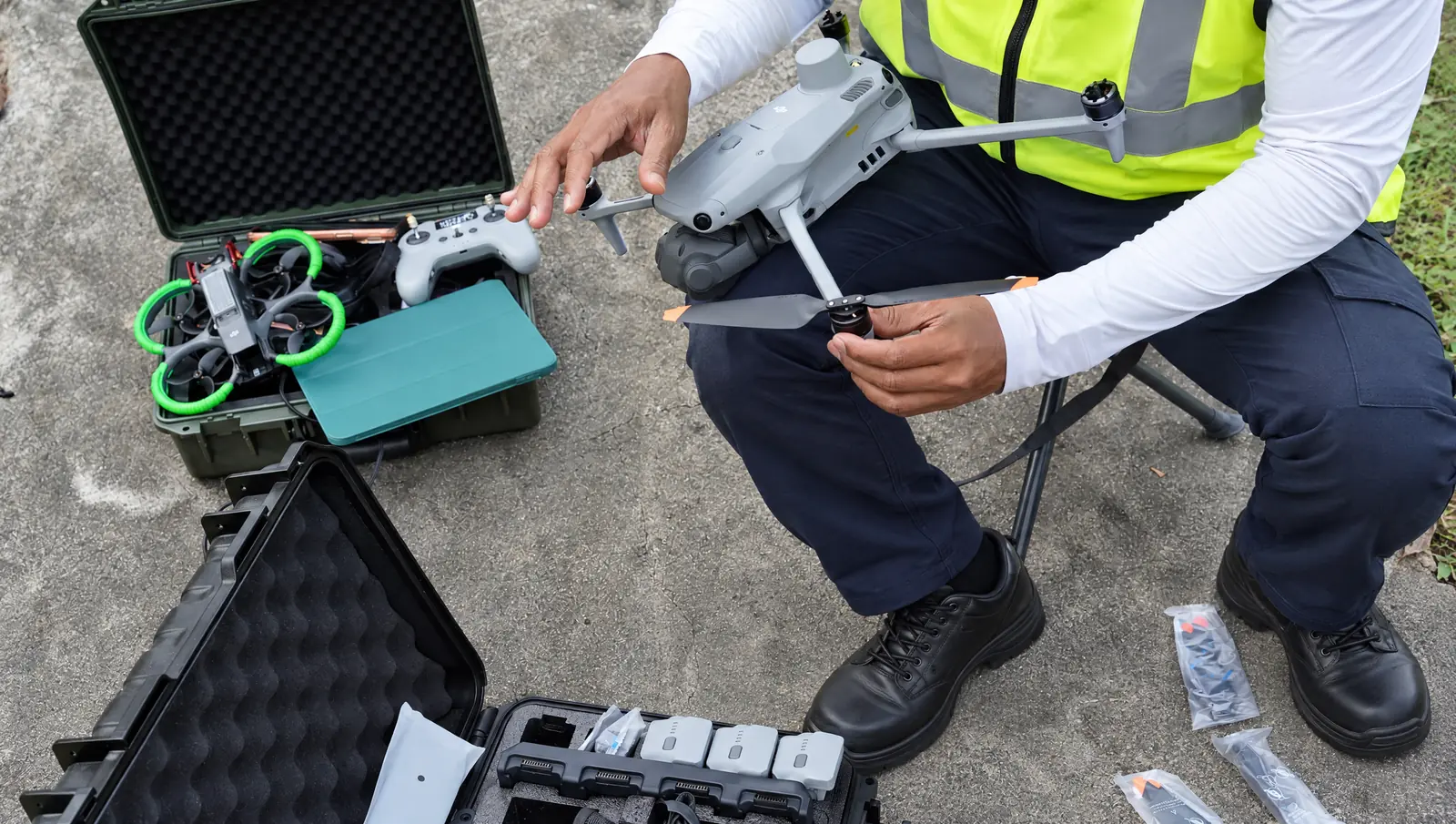
If you are planning to bring a drone onto your site — for a facade inspection, a site survey, a progress shoot or a corporate video — there is one question worth asking before anything else. Is the person flying it actually allowed to?
In Singapore, flying a drone for business is not a grey area. It is a regulated aviation activity under the Air Navigation (Unmanned Aircraft Operations) Regulations, and the requirements are stricter than most people assume. In some cases, those requirements reach the client who commissioned the flight, not just the operator who performed it.
Here is what the rules actually require, in plain English.
Do I need a licence to fly a drone for my business?
Yes. And unlike recreational flying, the weight of the drone makes no difference at all.
Anyone acting as the pilot of a drone in the course of business must hold a valid Unmanned Aircraft Pilot Licence, or UAPL, regardless of how light the aircraft is. A 900-gram drone flown commercially needs a licensed pilot. The same drone flown as a hobby does not.
This catches people out regularly. The familiar exemptions for small drones apply to recreation and education. They do not apply the moment money, a client or a commercial purpose enters the picture.
What is the difference between a licence and a permit?
This is the part most people miss. There are three separate authorisations, covering three different things, and a compliant commercial flight needs all of them in place at once.
| Authorisation | What it covers | Who holds it |
|---|---|---|
| UA Pilot Licence (UAPL) | Competency of the individual flying. Earned through a theory test, training with a CAAS-approved organisation, and a practical assessment by an authorised flight examiner. | The individual pilot. Class A covers drones up to 25 kg; Class B covers heavier aircraft. |
| UA Operator Permit (OP) | The organisation’s ability to operate safely: its structure, safety and risk-assessment procedures, aircraft airworthiness, and personnel competency. | The company. Valid for up to one year, then renewable. |
| Class 1 Activity Permit (AP) | The specific job: location, dates and times, operating altitude, and type of operation. | The company, per job. Not valid without an Operator Permit behind it. |
The three are linked rather than alternatives. A licensed pilot working for a company without an Operator Permit is not compliant. Nor is a permitted company flying a job it has no Activity Permit for.
What makes a flight more restricted?
Not all airspace in Singapore is equal, and a small island leaves very little margin. Additional restrictions apply when flying within five kilometres of an aerodrome, inside any gazetted restricted or danger area, above 200 feet, or anywhere near a protected area, where unauthorised flight or photography is treated as a serious offence in its own right.
One practical note worth repeating: OneMap is the authoritative source for checking no-fly zones in Singapore. The geofencing built into consumer drones is not, and will not always reflect local restrictions correctly.
Facade inspection sits at the more demanding end of this spectrum. The work happens close to occupied buildings, usually in dense urban areas, and often within restricted airspace. It is not a job that tolerates a casual approach to airspace planning.
Could we not just set this up in-house?
It is a fair question, and the honest answer is that you can, but it takes considerably longer and more effort than most companies expect. The route looks like this:
| Step | What is involved | Rough time |
|---|---|---|
| Register the aircraft | Mandatory for any drone over 250 grams. Buy a registration label from SingPost, in person or online, then complete registration on the CAAS portal. | 1–3 days |
| Licence the pilot | CAPELS account, theory test, training with an approved organisation, practical assessment with an authorised flight examiner, then the licence application itself. | 4–5 months |
| Obtain the Operator Permit | An organisational assessment, not a form. CAAS reviews safety management procedures, risk assessment processes, airworthiness records and personnel competency. Each additional drone type added to the permit later costs $500 and takes up to three weeks to approve. | 1–2 months |
| Apply per job | A Class 1 Activity Permit for every project, tied to a specific site, date range, altitude and operation type. Some locations take longer, because clearance is also needed from other government agencies. | 1–4 weeks, depending on location |
| Supporting pieces | Flight management system subscription, public liability insurance, and the internal documentation that holds it all together. | About 1 month |
The sequencing matters too. You cannot apply for an Operator Permit and write your safety procedures afterwards; the procedures are what you are being assessed on.
With pilot licensing alone taking four to five months, most organisations are looking at half a year or more before a single compliant commercial flight takes place. Then every new job still needs its own Activity Permit, one to four weeks ahead depending on location.
If my contractor is not compliant, am I exposed?
This is the question building owners and project managers tend to ask last, when it should be asked first.
The penalties under the regulations are not trivial. Operating without the required permits can attract a fine of up to $50,000, imprisonment of up to two years, or both, for a first offence, rising to $100,000 and up to five years for a repeat offence. Unauthorised flight or photography over a protected area carries the same range.
Set enforcement aside for a moment, though. If an unpermitted and uninsured drone damages a facade, drops onto a walkway or injures someone on your premises, you may find your own exposure is a great deal less contained than you assumed. The two minutes it takes to ask for permits and an insurance certificate removes that question entirely.
This is precisely the kind of risk a properly permitted operator is supposed to take off your plate.
What should I ask for before hiring a drone operator?
Five things cover nearly all of it:
| Ask for | Why it matters |
|---|---|
| The pilot’s UAPL | Must belong to the person flying on the day, not a colleague or a director. Check the class covers the aircraft being used. |
| The Operator Permit number | Confirms the company itself is assessed and permitted, not just the individual. Without it, no Activity Permit is valid. |
| A Class 1 Activity Permit | Should name your site, your dates and the intended altitude. A permit for a different location does not cover your job. |
| Public liability insurance | Ask for the sum insured, not just confirmation that cover exists. |
| The safety plan | Who is acting as safety officer on site, and what happens if something goes wrong mid-flight. |
Any legitimate operator will have all five to hand without hesitation. An operator who treats the request as unusual has told you something useful.
The short version
Commercial drone work in Singapore requires a licensed pilot, a permitted operator, and a permit for the specific job. Building that capability in-house is entirely possible, but it is a project measured in months, and the compliance burden does not end once the permits arrive. It renews, every year, for as long as you fly.
For most building owners and project teams, the sensible answer is simply to engage an operator who already carries all of it.
This guide is general information on Singapore’s drone regulations as at October 2026, not legal advice. For a specific site, check current requirements with the Civil Aviation Authority of Singapore. See also: how we keep operations safe and compliant and drone facade inspection.