
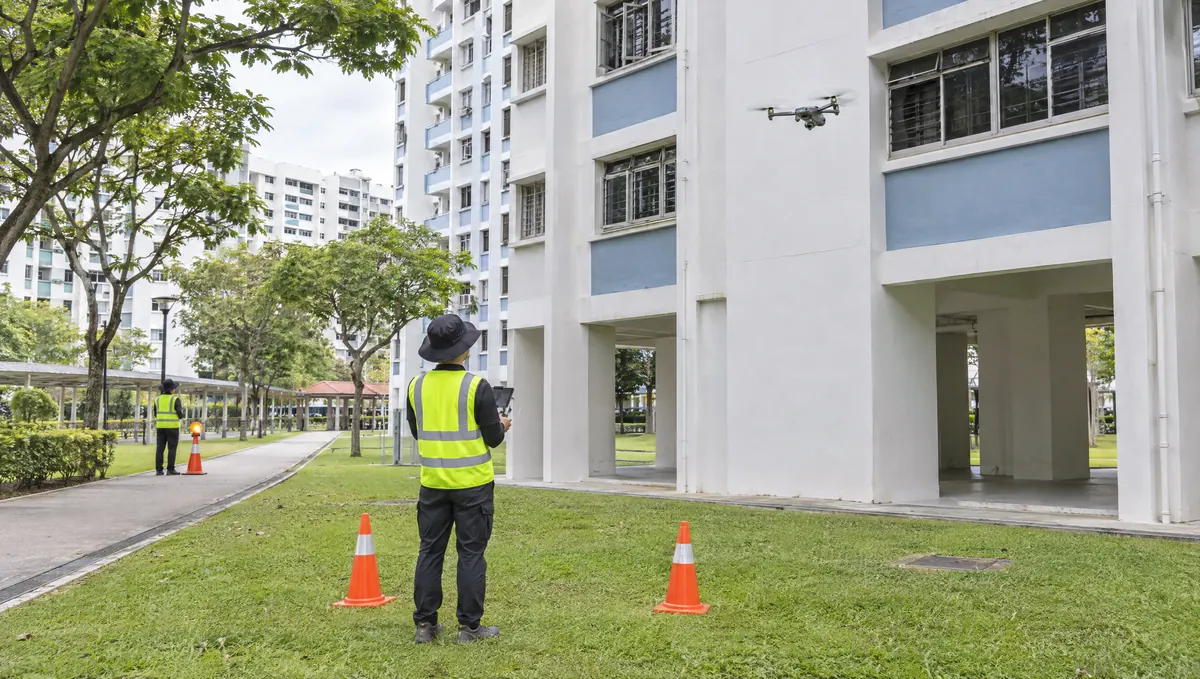
On the day of a drone inspection, residents might see a small crew in high-visibility vests, a few safety cones and a drone moving slowly up the side of the building. The flight itself often takes only a few hours.
Most of the work happens before anyone takes off. Permits, site checks, notices to residents and a safety plan all have to be in place first. On the day, the crew’s attention is as much on the people below as on the drone above.
Here is what that work involves, step by step.
What happens before the day?
Preparation usually starts weeks ahead. These are the main steps:
| Step | What we do | Why it matters |
|---|---|---|
| Site check | Check take-off points, rooftop and ground access, trees, covered walkways, overhead cables and nearby buildings, and look for sources of interference such as substations. Note the height above sea level of the take-off point and the height of the building. For larger or harder-to-reach sites, this is done at least three days before; otherwise it is part of the checks on the day. | Finds the hazards a map will not show, before they become a problem on the day. |
| Airspace check | Check the site on OneMap for no-fly zones, restricted areas and nearby airports, and for temporary restrictions during events such as the National Day Parade or the F1 race. | Decides which approvals are needed and how long they will take. |
| Permits and approvals | Apply for a CAAS Activity Permit for the site and dates. For a facade inspection, the Competent Person also gets BCA’s approval to use a drone. | No flight goes ahead without them. Some locations take up to four weeks. |
| Risk assessment and flight plan | Plan the flight paths, take-off and landing points, safety zone and emergency landing spots. | Everyone on site knows the plan, and what happens if something goes wrong. |
| Coordination with management | Agree with the MCST or building management on access to rooftops and lifts, parking for the crew, and the best days and times to fly. | Keeps disruption to residents and tenants to a minimum. |
| Notices to residents and neighbours | Prepare notices with the dates, flight times, what will and will not be photographed, and a contact for questions. The MCST, building management or town council displays them on notice boards and in lift lobbies. | For a facade inspection, residents must have at least three days’ notice. It also prevents surprise and complaints. |
| Weather and equipment checks | Watch the forecast (for example on NEA’s myENV app), and check the drone, batteries, controllers and software before the day. | Strong wind or rain can stop a flight, and faulty equipment should never reach the site. |
Most of the work happens before take-off
Weeks ahead
Airspace check and permits
CAAS Activity Permit, plus BCA approval for a facade inspection. Some locations take up to four weeks.
Before the day
Flight plan and coordination
Flight paths, safety zone and emergency landing spots. Access, parking and timing agreed with management.
3+ days before
Notices up
At least three days’ notice for a facade inspection. Larger or harder-to-reach sites are also visited.
Just before
Weather and equipment
Forecast watched. Drone, batteries, controllers and software checked.
On the day
Briefing, then the flight
The flight itself often takes only a few hours.
Why do residents get a notice?
A drone flying past someone’s window is unsettling if they do not know why it is there. A clear notice, issued in advance, answers the questions before they are asked.
We prepare the notice, and the MCST, building management or town council puts it up on notice boards and in lift lobbies. It explains when the drone will fly, that the camera is pointed at the building’s outer walls, not into homes, and who to contact with questions. Residents are also advised to close their curtains during the flight if they can.
For a facade inspection, the rules require at least three days’ notice, and images of faces, home interiors and vehicle number plates must be blurred.
What a notice to residents covers
Notice · Drone inspection
- WhenThe dates and flight times
- What is photographedThe building’s outer walls
- What is notThe inside of homes
- QuestionsA contact for questions
- A small requestClose your curtains during the flight if you can
Facade inspection
3 days
minimum notice to residents
Where it goes up
Notice boards and lift lobbies, put up by the MCST, building management or town council
In the images
Faces, home interiors and number plates are blurred
What happens on the day?
On the day, the crew works through a fixed routine:
| Step | What happens |
|---|---|
| Safety briefing | The crew and building management go through the flight plan, the safety zone, each person’s role and the stop rules. |
| Marking the area | There is no need to fence off a large area. One or two safety cones mark a space of about three metres around the pilot, and the pilot and spotter wear high-visibility vests so drivers and pedestrians can see them. |
| Roles on site | The pilot flies and keeps the drone in sight at all times. The spotter carries a safety cone with a flashing light, keeps pedestrians and vehicles clear, and watches out for the pilot, who is focused on the screen and may not notice passing traffic or an open drain. The safety officer oversees the operation and can stop work at any moment. |
| Flight logging | Each flight is logged with CAAS through its FlyItSafe system before take-off and closed after landing. |
| Stop rules | The flight stops if the wind rises above the drone’s limits, if it rains, or if the pilot loses sight of the drone. Remaining work is rescheduled. |
When the flight stops
Wind
Above the drone’s limitsWeather
It rainsVisibility
The pilot loses sight of the droneResult
The flight stopsRemaining work is rescheduled.How do we keep people and traffic safe?
The biggest risks on an inspection day are on the ground, not in the air. Drones are flown close to occupied buildings, often next to car parks, driveways and footpaths.
- We avoid flying over people and plan flight paths around entrances and busy walkways. We do not fly over main roads, unless a road closure permit has been approved, a traffic marshal is on site and CAAS has been informed.
- Where a footpath or driveway runs under the flight path, the spotter holds people back for the few minutes the drone is overhead.
- Flights are timed around the building’s quieter hours where possible, such as avoiding school pick-up times at a condominium.
- Gusty winds between tall blocks affect how steadily a drone can fly. Separately, magnetic interference can disturb its compass when it flies close to large metal structures, such as telecom towers, piers or large ships. Both are checked and planned for in advance.
Who does what on site
- 1PilotFlies and keeps the drone in sight at all times, inside a space of about three metres marked by one or two safety cones.
- 2SpotterCarries a safety cone with a flashing light and holds people back for the few minutes the drone is overhead.
- 3Safety officerOversees the operation and can stop work at any moment.
- 4Flight pathPlanned to avoid flying over people, and around entrances and busy walkways.
What happens after the drone lands?
- The images are checked on site, so any gaps can be filled the same day instead of returning later.
- If the images show an urgent danger, such as a dislodged window or loose concrete on the facade, we tell building management straight away so the area below can be cordoned off.
- The flight log is closed, and any incident is reported to CAAS as the regulations require.
- Faces, home interiors and number plates are blurred, and the images are stored securely and released only to the client.
- The site is cleared, and management is told the work is complete.
The short version
A drone inspection is far more than a flight. It takes a site visit, permits, a risk assessment, notices to residents and a safety plan before take-off, and a trained crew on the ground keeping people and traffic clear while the drone works.
That is the part of the job you do not see, and it is what separates a professional operation from someone flying a drone on their own.
See also: PFI Singapore: drone facade inspection, what a drone operator needs to fly legally, whether to fly your own drone or hire a professional and how we keep operations safe and compliant.